

The Georgian Dream is a Democratic Nightmare
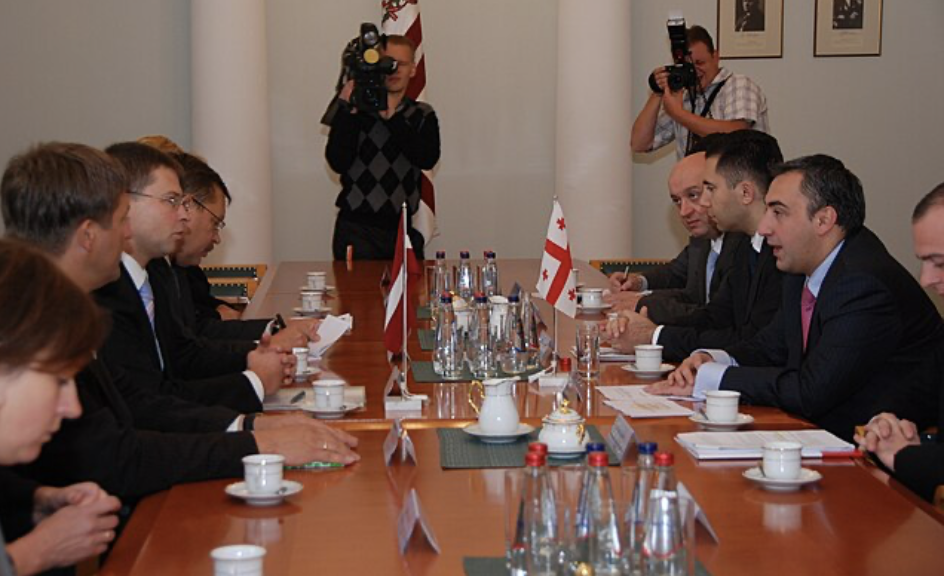
Source: Wikimedia Commons/Official visit of Georgian Prime Minister Nika Gilauri to Latvia
On October 4th, the people of the nation of Georgia went to the polls to elect their local officials. Unfortunately, the people were not heard. With a voter turnout rate of 40%, allegations of vote buying, and a boycott by opposition parties to any elections held under the Georgian Dream, these elections represented the interests of pro-Russian elites as well as a limited number of neutralists in the conflict between the EU and US against Russia. The party which, under Giorgi Margvelashvili (2013-2018), promised reform and pro-EU policies has slowly become the very government it swore to reject; an oligarchic, corrupt, and authoritarian regime that silences critics and suppresses dissent.
Starting first and foremost with the Foreign Agents Law under the leadership of Prime Minister Kobakhidze (2024-Present) and President Mikheil Kavelashvili (2024-Present), this legislation was nominally meant to limit external influence in Georgian politics by labeling organizations that receive 20% or more of their funding from outside the nation as advancing foreign interests. This was a direct assault on the influence of non-governmental organizations (NGOs) which are primarily used by pro-EU and pro-West civil society organizations rather than against malign influence from Russia. As seen through their sabotage, online disinformation, and public influence campaigns against its own people, Russia does not traditionally use NGOs in order to gain power over nations, including its own, showing that the Foreign Agents Law was primarily targeted at the West and the EU.
Nevertheless, Kobakhidze has occasionally walked back some of his more anti-EU rhetoric, and still seems to be open to the idea of EU membership. He understands the importance of Georgia politically, geographically, and economically as a transit corridor between east and west, and so he has emphasized that Georgia’s ascension to the EU will continue – albeit it has been suspended since November of 2024. Even with this confirmation that the path to EU membership for Georgia will not be stopped – at least by Georgia – he also blamed the EU Ambassador to Georgia for election interference in the local elections, showing very inconsistent rhetoric in his views on the EU and Georgian membership in the EU.
In the local elections, there were many allegations of vote buying, intimidation, and Russian interference, much like the 2024 Parliamentary Election. Many election observers, specifically the Office for Democratic Institutions and Human Rights, were not allowed to meaningfully observe these elections. Those who observed the elections and confirmed these allegations, which were coupled by an opposition boycott and low voter turnout. For these reasons, the Georgian Dream, rather than bringing reform like the administration of President Mikheil Saakashvili (2003-2007, 2008-2013), has brought an even more autocratic regime than any other time period of post-Soviet Georgian history.
In order to determine the level of autocracy in the Kobakhidze administration, it is best to compare his administration to that of President Mikheil Saakashvili – as Kavelashvili has less power than Kobakhidze as of writing. In order to do this, it is necessary to look at their detractors and the limits they placed on both civil society and the legislative system. Many accusations levied against Saakashvili deal with the judicial system, where he was accused of arresting political opponents and not reforming the system where plea bargaining was prioritized above even justice in some instances. While Saakashvili imprisoned political opponents at times, Kobakhidze has called for mass arrests due to protests in the wake of the illiberal and unfair elections of October 4th. Kobakhidze has claimed that the EU and the US State Department have interfered with the elections, and while he may be correct that the EU and US are supporting NGOs which support pro-West and pro-EU policies, he and Bidzina Ivanishvili – who founded the Georgian Dream – have claimed that protestors are acting as agents of foreign entities, something which is very likely false. These accusations from Kobakhize and Ivanishvili have been used as pretext to arrest protestors and opposition leaders who participated, much worse than actions taken by the Saakashvili administration.
Overall, while the Georgian Dream, and post-Soviet Georgia as a whole, began as a reformist party under Giorgi Margvelashvili (2013-2018), under the latter half of Zourabichvili and especially under Kobakhidze/Kavelashvili, the Georgian Dream has turned into a nightmare for democracy in Georgia, much worse than the extreme reforms and abuse of the judicial system under Saakashvili. While Saakashvili may have some authoritarian measures taken in common with Kobakhidze, the crackdown on general opposition parties combined with likely vote buying and mass arrests of opposition figures show how Kobakhidze and Ivanishvili have turned the Georgian Dream, which was moderately reformist under Margvelashvili, into an authoritarian party which will likely end the democratic experiment in Georgia for the next couple of decades.