

Silence Is Not Strategy: India’s Multipolar Problem
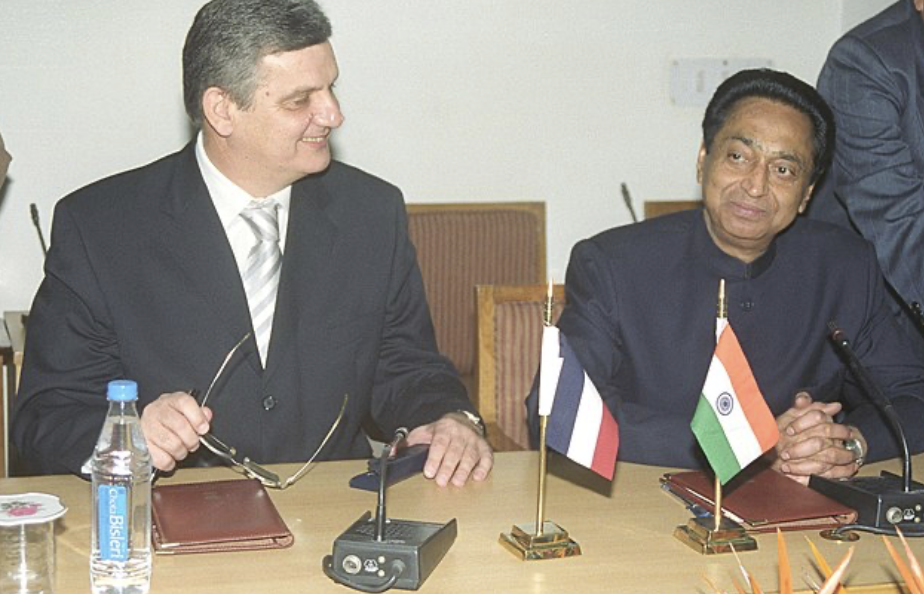
Source: Wikimedia Commons / Kamal Nath and the Minister of International Economic Relations of Serbia & Montenegro
“If you stand for nothing, Burr, what’ll you fall for?” Lin-Manuel Miranda’s Hamilton poses this question to Aaron Burr as a challenge to Burr’s political neutrality and, perhaps unknowingly, to the logic of modern diplomacy. If an individual refuses to take a stand on an issue vital to their existence, what will they ever rise for? The same paradox now confronts nations.
One country that has long embodied Burr’s neutrality is India, which, since its independence in 1947, has proudly embraced a policy of nonalignment refusing to side with any power bloc during the Cold War. For decades, that strategy worked. It allowed India to expand its influence and maintain autonomy between Washington and Moscow. But in the twenty-first century, that same posture is becoming increasingly obsolete.
For much of the modern era, India’s balancing act, between the U.S. and Russia, between the norms of the West and solidarity with the South, gave it leverage. New Delhi could speak to Washington without alienating Moscow and lead the Global South without antagonizing the West. Yet as today’s geopolitical landscape hardens into sharper poles, that ambiguity now limits India’s influence.
To the U.S., India now emerges as a hesitant partner, eager for technology and defense cooperation but reluctant to stand with America on issues like Ukraine or global human rights advocacy. To Russia, India now is seen as opportunistic: buying Russian arms and oil while steadily deepening ties with Washington. Lastly, to the rising dragon of the east, China watches as India’s rhetoric of multipolarity sounds hollow given its participation in the U.S. led QUAD and clashes with Chinese forces. Yet the image of such strategic interest turns into strategic indecision: everyone talks to India, but no one fully trusts it. In diplomacy, power depends as much on predictability as it does on capability. And right now, India’s partners see calculation, not conviction.
As India continues clinging to ambiguity, the country risks ceding the leadership of the Global South - the very bloc it helped pioneer – to faster-moving, more assertive powers. Brazil has reclaimed its moral credibility under the precise leadership of Lula Da Silva positioning itself as the Global South’s climate advocate and peace broker evidenced by its hosting of the COP30 Climate Conference in November 2025. Similarly, The UAE and Saudi Arabia have leveraged wealth and diplomatic pragmatism to become the new hubs of Global South diplomacy – hosting peace talks, diplomatic conventions and security mediation. Lastly, Indonesia and Mexico have demonstrated their ability to build reputations as regional leaders bridging the gap between the global north and south.
These countries may lack India’s scale, but they possess something India increasingly does not: clarity of posture. Each of the aforementioned nations has staked a distinct identity - climate broker, diplomatic power, and regional intermediary - while India remains caught between aspiration and caution. In global politics, such hesitation creates a vacuum and global power vacuums never stay empty.
The tragedy of India’s indecision is that it once had the moral architecture to lead: a democracy capable of speaking for billions, a civilizational narrative grounded in diplomatic pluralism, and an economy dynamic enough to anchor the developing world. But by over-managing its image, abstaining here, hesitating there, and avoiding confrontation everywhere, India is losing the resource that multipolar diplomatic policy rewards the most: trust.
India’s balancing act was once its genius. Today, it is its constraint. If New Delhi continues to play both sides, it risks watching others define the very Global South it hoped to lead. The moral capital that once made India indispensable may soon migrate — to Brasília’s idealism, Riyadh’s ambition, Jakarta’s pragmatism, or Mexico City’s regional assertiveness.
The world’s largest democracy cannot afford to be the quietest voice in it. Even Hamilton recognized that “it is better to be divisive than to be indecisive.” Like Burr during the election of 1800, India risks losing the influence it spent decades building - not through aggression or arrogance, but through the illusion that silence is strategy.