

The Politics of Eurovision
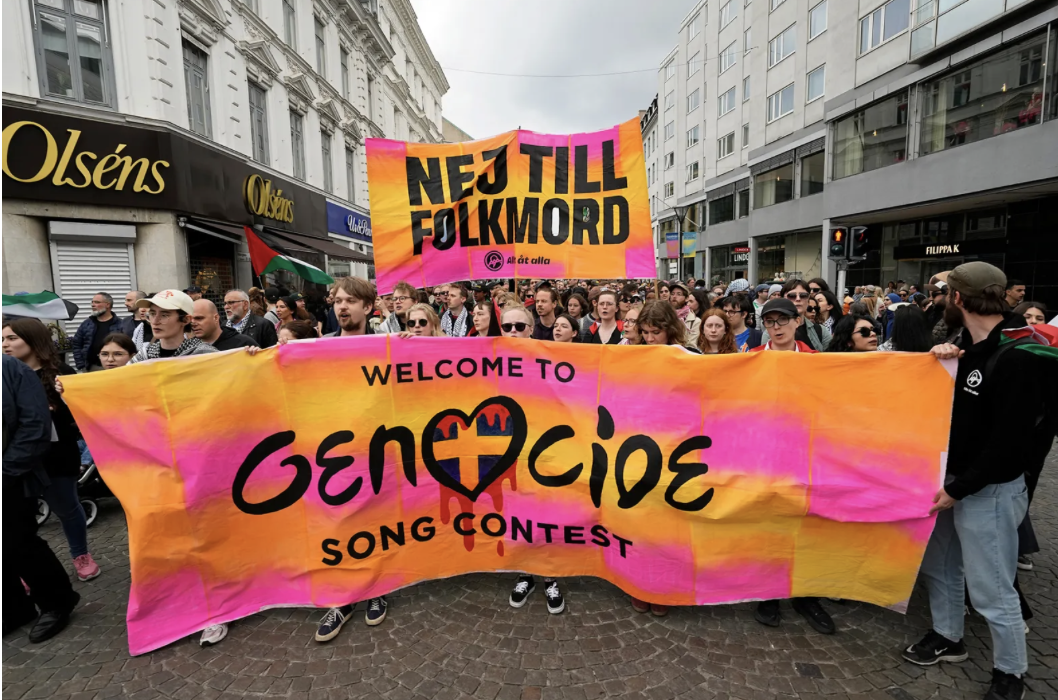
Pro-Palestinian protestors at a demonstration ahead of the second semi-final at the Eurovision Song Contest in Malmo, Sweden, 2024, Rolling Stone
Introduction
On December 4, 2025, Israel was cleared by the European Broadcasting Union to compete in Eurovision 2026. A few hours later, Ireland, Spain, Slovenia, and the Netherlands withdrew from the competition. On December 10, 2025, Iceland joined the boycott. Broadcasters in these five countries cited Israel’s disregard for the competition’s rules, the death count in Gaza, and the ongoing war in Gaza as reasons for the boycott. Meanwhile, the Israeli government has celebrated the country’s inclusion. This ongoing controversy demonstrates that while Eurovision claims to be politically neutral, the contest is inherently political and influenced by public opinion.
The History of Eurovision
The first Eurovision contest was held on May 24, 1956, and had seven nations compete: the Netherlands, Switzerland, Belgium, Germany, France, Luxembourg, and Italy. The contest originated with the introduction of the Eurovision Network by the European Broadcasting Union (EBU) in 1954, with the goal to unite people through music in post-WWII Europe.
Each participating broadcaster from the participating country has until mid-March to choose a song and artist to perform, and participants compete at the contest in May. Then, the contest has three live shows: the First Semi-Final, the Second Semi-Final, and the Grand Final. In each show, each country will give two sets of points (1, 2, 3, 4, 5, 6, 7, 8, 10, 12) to their favorite songs, one by a jury of five music industry professionals, and one by viewers watching in that country. People cannot vote for their own countries. In the semi-finals, only audience points count towards qualification, while in the Grand Final, audience and judge points are counted.
Since its origin, the contest has been held 68 times with 71 winners and 52 total countries competing. Initially, artists entered songs sung in their native tongues, but as the event grew in popularity, songwriters began to submit songs with greater universality in their lyrics and language. The winner earns widespread recognition and a glass trophy. Additionally, the winner’s homeland is accorded the rights to host the contest the following year. While participating in Eurovision does not guarantee future success, it has been instrumental in launching the careers of Julio Iglesias, ABBA, and Céline Dion.
Previous Eurovision Politics and Controversies
Since its formation, Eurovision has faced numerous political controversies. In accordance with the EBU’s rules, any politicization of the contest is prohibited, including lyrics, speeches, or gestures of a political nature. In 2009, following the Russo-Georgian war, Georgia submitted their song titled “We Don’t Wanna Put In” to the contest, held in Russia that year. This song was deemed to have clearly political lyrics aimed at Vladimir Putin. Georgia chose to withdraw rather than change the lyrics, claiming the song did not have political statements.
In 2016, during the first semi-final, Armenian singer Iveta Mukuchyan waved the flag of Nagorno-Karabakh, a disputed region between Armenia and Azerbaijan. Armenia was sanctioned by the EBU for its breach of the ban on political messages and warned it could be excluded from the contest if a breach of contract occurred again.
During the selection process for Eurovision 2021, the EBU determined that Belarus’s entry, “Ya Nauchu Tebya,” broke the rules regarding political lyrics. The song was believed to be political propaganda mocking the country’s protests against President Alexander Lukashenko. While the lyrics were amended, these new lyrics were also deemed unsuitable, so Belarus was disqualified from the contest for that year.
In 2022, following its full-scale invasion of Ukraine, Russia was excluded from Eurovision. However, the EBU initially showed reluctance, only banning Russia after growing pressure from several national broadcasters, widespread public criticism, and threats of boycotts. The ultimate decision was justified on the basis Russia’s inclusion would disgrace the competition and undermine the contest’s core values. Therefore, Russia’s ban demonstrates that violation of international norms can justify exclusion, but this principle is not always applied uniformly.
In previous years, non-national symbols, such as the pride flag and the flags of recognized international organizations, like the EU, had been permitted. However, in 2024, the EBU introduced a stricter flag policy, allowing artists to only bring national flags on stage while subjecting fans to the same rules. The ban included the EU flag and pride flags since they are not national flags, drawing criticism from EU officials for discouraging unity and from LGBTQ+ groups for the step backward in representation. While the ban was relaxed in 2025 to allow fans to bring any flag as long as it wasn’t hateful or offensive, artists were still subjected to the same strict rules of 2024. Furthermore, performers can only display their national flag, meaning they cannot display another country or territory’s flag as an act of solidarity with a group of people, such as the Palestinian and Ukrainian flags.
Nevertheless, not all performances that could be considered political are banned. Ukraine’s entry in 2016, “1944” addressed the deportation of Crimean Tatars by Soviet forces during WWII, with lyrics referring to Russia’s annexation of Crimea in 2014. Nevertheless, the entry was accepted as a personal and historical reflection.
In 2023, during their performance of “Mama ŠČ!” Croatia’s performers dressed as apparent dictators, accompanied by prop missiles. They delivered a satirical critique of authoritarianism, with references to authoritarian leaders like Vladimir Putin and Alexander Lukashenko. This performance was allowed, demonstrating the blurred line between artistic expression and political messaging.
Eurovision Politics and Israel
In 1973, Israel became the first non-European country to join Eurovision. Since its introduction, Israel’s participation has been surrounded by controversy:
In 1978, Jordan’s broadcasting company stopped the live broadcast once it was clear that Israel would win, and instead presented the song from Belgium, the country in second, as the winning entry.
Many Arab countries have chosen not to participate in Eurovision because of Israel’s presence. In 1977, Tunisia attempted to participate, but withdrew shortly before, as the broadcaster did not want to broadcast Israeli content. A similar incident occurred in 2005 with Lebanon. Morocco did take part in the competition in 1980, the same year Israel withdrew due to the contest coinciding with the country’s Holocaust Remembrance Day, but no Arab country has participated since.
During Eurovision 2000, Israel’s broadcasting authority disowned its own entry because the performers waved Syrian flags during rehearsal, calling for peace between Israel and Arab countries.
In Eurovision 2024, Israel’s act, Eden Golan, was originally due to perform a song titled "October Rain." This song, with both its name and lyrics, was thought to have political messages related to the conflict in Gaza. Following backlash, the lyrics and title of the song were changed to allow Israel’s participation in the contest.
In May 2025, an open letter addressed to the EBU was cosigned by 72 musicians and performers, calling for Israel’s ban of the contest over the country’s "genocide against the Palestinians in Gaza and the decades-long regime of apartheid and military occupation against the entire Palestinian people.” Controversy continued when, during Eurovision 2025, Israel received the highest number of public votes, nearly twice as many as Austria. The Israeli government engaged in a vote lobby campaign of unprecedented scope through state social media channels and cross-platform advertising, contributing to a large amount of public votes. Despite Israel winning the pubic vote, Austria won the contest because of a significantly stronger performance in the jury vote. This outcome raised the question of whether voting was based on the performances or if political considerations may have influenced the results, which undermines Eurovision’s claims that votes come from artistic merit, not political considerations.
Hoping to prevent future controversy and improve neutrality, on December 4, 2025, broadcasters of the EBU did not vote on Israel’s participation but instead voted to introduce new rules designed to stop governments and third parties from disproportionately promoting songs to influence voters. Fans will now only be able to cast 10 votes each, down from 20, and juries will return for the semi-finals. Without a direct vote on Israeli participation, the country was cleared to participate in the contest.
Implications and Conclusions
Austria, this year’s host country, stated it will continue with plans to host next year’s Eurovision despite its budget being hit by the five countries boycotting the contest. No further countries have withdrawn, with Austria and Germany in full support of Israel’s participation, and Sweden, Finland, Norway, Denmark, and Iceland expressing support for the EBU’s public voting changes.
The boycott will likely have massive implications for Eurovision. The countries boycotting will not send a musical act to the contest and will not broadcast it, cutting viewership. Further protests are likely to occur in response to Israel’s inclusion.
Furthermore, there is likely to be a great impact on funding. Eurovision is funded by participating broadcasters, with the richest countries paying the most; the host broadcaster; and the host city. Spain is one of the big five countries that automatically qualify for the final due to the size of their financial contribution. This means other countries will now have to pick up the bill. However, this may be a difficult feat for countries to accomplish. In 2016, Romania was excluded from Eurovision for refusing to pay debts dating back to 2007. This case demonstrates how finances are a consideration for country participation. If countries cannot afford the competition, they may not participate in future years.
The inclusion of Israel also demonstrates decisional discrepancies of the EBU, with political opinion interfering with decision-making. While Belarus was excluded from the contest in 2021 due to political lyrics, there is also a general political consensus among EU countries that Lukashenko manipulates elections in Belarus and is an authoritarian dictator.
Meanwhile, Russia’s invasion of Ukraine was a clear violation of international law. However, other acts that could be considered politicized, like Ukraine’s performance in 2016 and Croatia’s in 2023, were not excluded because their messages were largely supported by EU countries. A similar pattern follows for Israel. Many Western countries support Israel, or at least refuse to condemn it, contributing to the lack of a ban in the country, despite Israel’s role in the war in Gaza. Therefore, it is clear that political opinion has a great influence on which acts are considered “political” and “harmful.”
Despite Eurovision’s official slogan “United By Music,” politics have played a great role in the contest, dividing countries. Music, as a form of art and expression, has always been political. With Eurovision’s longly politicized history, it is unlikely to change in the future, meaning politics will continue to be a significant part of the contest.