

Sudan: On the Brink
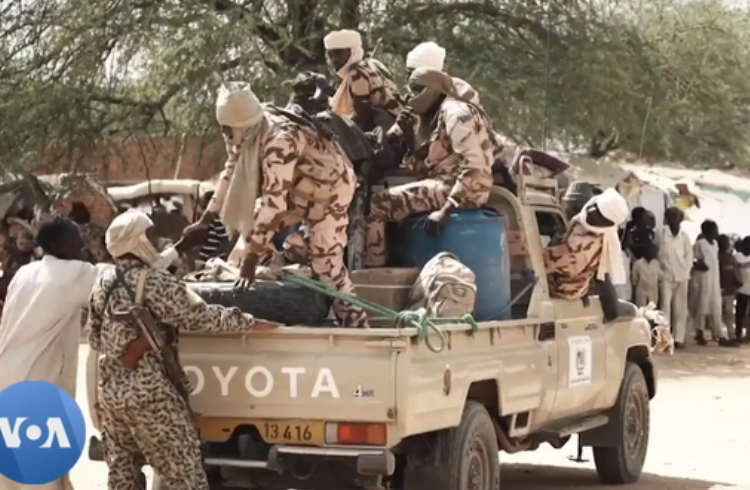
Source: Wikimedia Commons / Chadian soldiers at the Chad-Sudan border oversee the crossing of refugees fleeing the civil war in Sudan.
Sudan is currently experiencing one of the world’s worst humanitarian crises. The Sudanese Armed Forces (SAF), under the command of General Abdel Fattah al-Burhan, and the Rapid Support Forces (RSF), under the command of General Mohamed Hamdan Dagalo, also known as Hemedti, have been engaged in a bloody conflict. It has now grown into a full-blown civil war that has displaced and killed millions, leveled cities, and thrown the nation of Sudan into chaos.
The origins of this conflict can be traced back to 2019, when dictator Omar al-Bashir was overthrown and Sudan underwent a failed democratic transition. After al-Bashir was removed, there were hopes for a democratic and civilian-led government, but this hope didn’t become reality as the power struggles between military leaders stopped this progress. By October 2021, Burhan and Hemedti had staged a coup to seize complete control, essentially making the transitional government helpless. However, the tensions between the two generals increased when the RSF integrated with the national army—this would have led to a return to civilian rule in Sudan. Of course, neither sides or generals trusted one another, so fighting erupted in Khartoum, Sudan’s capital, in April 2023, marking the start of this brutal civil war.
Since that time, Sudan’s largest cities have become battlegrounds, endangering millions of innocent civilians. The SAF is in control in the east and the North, and the RSF controls mostly the west. Civilians are in the crossfire, facing airstrikes, looting, and sexual violence. Both the SAF and RSF have committed extreme human rights violations, including mass killings and ethnically targeted violence. This is especially true in Darfur.
Darfur is the center of the war’s atrocities. The RSF and allied Arab militias have targeted many non-Arab populations. Many citizens have been killed based on ethnicity. Entire villages have been looted and burned. This has caused thousands to flee (mostly across to Chad). All these instances are very similar to the Darfur genocide of the early 2000s. Humanitarian access has been restricted and there is little punishment for perpetrators. Darfur is one of the most urgent human rights crises in Sudan.
According to the United Nations, 10 million people have been displaced. Over half the population, 25 million people, need urgent aid. Hospitals have been destroyed even as outbreaks of cholera and malaria spread. Food supplies are running out, leaving entire families to survive on rations. Aid agencies warn that famine is near and will claim thousands of lives if humanitarian access is not restored soon. This situation is especially worse for women and children who are subject to severe malnutrition and gender-based violence.
All previous peace efforts have all failed. The United States, Saudi Arabia, and the African Union have all tried to mediate multiple ceasefires and none have come to fruition and have fallen apart in days. Regional powers aren’t helping towards peace efforts either: Egypt allegedly supports SAF and the UAE is allegedly supporting the RSF with weapons and funding. Also, the global community’s focus on other major conflicts like Gaza and Ukraine has left Sudan’s civil war out of the spotlight and underfunded.
Refugees are fleeing to neighbors like Chad, South Sudan, and Ethiopia—this is straining the fragile economies and resources of these countries. Additionally, smuggling and the flow of arms further exacerbate insecurity. On top of all this, Sudan is in a strategic Red Sea location and has also attracted foreign interest. Both Russia and Western states want influence over potential naval access points. If this instability increases and continues, it could allow for greater global interference.
Even though the situation looks very bleak, civil society groups in Sudan continue to fight for peace. Many of the organizations that led the 2019 revolution are calling for a commitment to democracy and human rights, but their voices have been minimized by the ongoing violence.
All in all, Sudan’s civil war is not just a battle between two generals. It is a collapse of a fragile political system that once offered hope of democracy. It shows the importance of unchecked militarization and international neglect. As this human rights crisis increases, the global community has to face a moral test: whether to allow Sudan’s people to continue to suffer or mobilize humanitarian action to help and bring peace to a nation on the brink of collapse.