A Legacy of Failure: The Budapest Memorandum, a Generation On
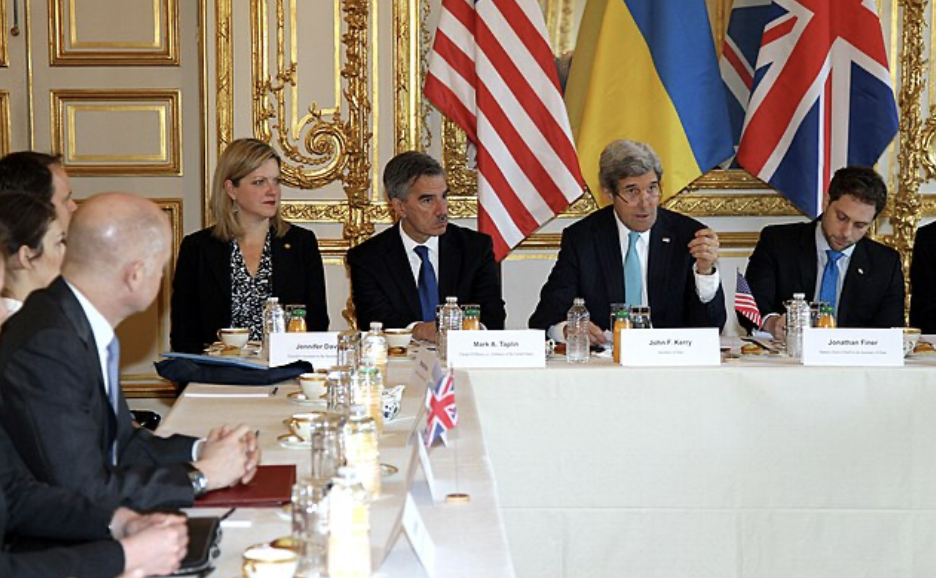
Source: Wikimedia Commons / Secretary Kerry Addresses the Budapest Memorandum Ministerial on the Ukraine Crisis
The 1994 Moment
On December 5, 1994, at the Conference on Security and Co-Operation in Europe (CSCE) summit in Budapest, Russian President Boris Yeltsin publicly clashed with U.S. President Bill Clinton over NATO enlargement, warning that Europe risked entering a “Cold Peace,” once again dividing East from West. The phrase instantly resonated in Western foreign policy circles, where the Clinton Administration was struggling to articulate a unifying post–Cold War vision.
Washington hoped it could simultaneously stabilize the liberal order, integrate postcommunist states into the West, and build a cooperative relationship with democratic Russia — a balancing act that, in hindsight, proved unsustainable. By the mid-2010s, the “Cold Peace” had collapsed entirely. Despite attempts at outreach by Presidents Obama, Biden, and Trump, relations with Moscow hardened into confrontation, and Russia, now mired in its fourth year of aggression against Ukraine, continues its escalation of hybrid operations across Europe.
With Ukraine’s emergence as the central defender against Russian expansionism, policymakers and commentators have begun reassessing a second event from that same December day in 1994: the signing of the Budapest Memorandum, which finalized Ukraine’s accession to the Non-Proliferation Treaty (NPT) and removed the nuclear deterrent it inherited from the Soviet collapse. Since Russia’s 2014 seizure of Crimea and its 2022 full-scale invasion, the Memorandum has been repeatedly invoked by high officials and lay audiences alike to question whether Ukraine was misled, abandoned, or promised protections that never materialized.
This article clarifies the agreement by outlining its political context, terms, and the extent to which signatories have violated it.
Political-Historical Context
Ukraine, the US, the United Kingdom, and Russia signed the Budapest Memorandum to promote regional stability and advance post-Cold War arms control. The urgency stemmed from several realities:
Upon independence, Ukraine inherited the world’s third-largest nuclear arsenal – over 1,900 strategic warheads and thousands of tactical weapons — many deteriorating as Kyiv faced severe economic strain.
Russia, as the legal successor to the USSR and holder of its UN Security Council seat, sought rapid transfer of the weapons.
Kyiv distrusted Moscow’s intentions, amid both tensions over the arsenal and rising irredentist rhetoric in Russia.
The United States wanted to prevent nuclear trafficking and consolidate oversight under a single state, remarkably aligning Washington and Moscow’s interests.
Terms and Ambiguities
The Memorandum consists of just six articles and was crafted to satisfy competing demands: Ukraine sought an “international legal document,” while other signatories wanted political assurances without parliamentary ratification.
Only Article 2 is unambiguously binding under the English text, reaffirming, based on the United Nations (UN) Charter, that signatories will not use or threaten force against Ukraine’s territorial integrity or independence.
Four clauses express “commitments” modeled on the Helsinki Accords and the NPT:
Article 1: Respect for Ukrainian sovereignty and borders.
Article 3: No economic coercion to subordinate Ukraine’s sovereign rights.
Article 4: UNSC action if Ukraine faces aggression involving nuclear weapons.
Article 5: No nuclear weapons use against Ukraine except in self-defense against a nuclear-armed ally.
Article 6 requires consultations between signatory parties if concerns arise.
However, the three authentic language texts diverge in content. The Ukrainian text uses zobov’yazannya (“obligation”) in every clause and states that the Memorandum “take force upon signing,” a technically legally binding phrase under the International Court of Justice’s Qatar v. Bahrain ruling. The Russian version also lacks clear distinctions between commitments and obligations, though it keeps the English text’s legally softer phrasing that the Memorandum “becomes applicable upon signing.”
Under the narrowest reading, Budapest is almost entirely nonbinding and unratified by all but Ukraine. Under the broadest terms, it carries legal force but lacks force amid non-ratification, an inherent limitation for an agreement meant to create a stable security framework in Eastern Europe.
Russia: The Primary Violator
Russia has repeatedly violated both the letter and spirit of the Memorandum, especially Articles 1 and 2:
2003: Moscow attempted to seize Tuzla Island in the Kerch Strait, disputing Ukraine’s 1991 borders and deploying naval forces. Although resolved through a bilateral treaty, the episode constituted a breach of territorial integrity.
2014: After Ukraine’s Revolution of Dignity, Russia occupied and annexed Crimea through a staged referendum and actively sponsored and supported separatist forces in the Donbas.
2022: Moscow recognized the separatist Donetsk and Luhansk People’s Republics and launched a full-scale invasion, later claiming to annex four Ukrainian regions it did not fully control.
Russia has also plausibly violated Article 3, conducting acts of economic coercion like blockading Kyiv’s grain exports after 2022. Its nuclear signaling, however, is more ambiguous: while Russian officials avoid explicit nuclear threats against Ukraine, state media figures have issued them publicly, and the Kremlin has officially upped the ante by revising its nuclear doctrine – expanding Russia’s prerogative to use nuclear forces in conventional scenarios – and even by conducting maneuvers consistent with nuclear mobilization in late 2022.
Russia’s conduct thus renders its 1994 signature effectively meaningless.
The United States: A Likely Case of Violation
Although the US insisted the Memorandum should remain non-binding to avoid Senate ratification, Washington has increasingly departed from its own commitments, especially under the first and second Trump Administrations. Ukraine has not formally invoked the terms of the Memorandum against the US, but recent behavior raises two concerns.
First, while the Obama Administration maintained that Russia’s annexation of Crimea was illegal, President Donald Trump repeatedly asserted in his first term that “Crimea was Russian.” Since returning to office, the Trump Administration has at times pressured Kyiv to concede territory in exchange for ceasefire terms. The initial Russia-friendly 28-Point Plan for peace included provisions requiring Ukraine to accept the loss of Crimea, Donetsk, and Luhansk, thus directly contradicting Washington’s declaration to respect Ukraine’s 1991 borders. Through several rounds of negotiations over the weeks since have changed the terms of the deal and made its ultimate fate quite uncertain, Washington’s abrogation of respect for the inviolability of the 1991 borders could well re-occur.
Article 3 prohibits economic coercion to secure advantages. Yet in 2019, President Trump sought to pressure Ukrainian President Volodymyr Zelenskyy into opening a domestic investigation into the Biden family while withholding $400 million in congressionally approved military aid, an episode that led to Trump’s first impeachment.
In his second term, though the Biden scandal has passed, coercive leverage has continued. After a disastrous Oval Office meeting between President Trump and President Zelenskyy in early 2025, the White House suspended military assistance and intelligence sharing, resuming only after Ukraine signaled openness to a ceasefire. US negotiators again threatened to halt support during Spring 2025 talks over a rare-earth mineral deal, and after presenting the 28-Point Plan announced that aid would be cut if Kyiv refused, risking battlefield collapse amid significant advances by Moscow around Kharkiv and Donetsk Oblasts.
In practice, these actions fall far short of honoring the Memorandum’s provisions for Ukraine’s benefit, even if Moscow remains the predominant threat to Kyiv’s continued independence.
Budapest and the Unraveling Liberal Order
In the mid-1990s, the Budapest Memorandum appeared to offer a pragmatic solution: Ukraine would relinquish nuclear weapons in exchange for political assurances, and the post-Cold War order would advance non-proliferation without expanding formal security guarantees.
Three decades later, the outcome is stark:
Russia consolidated the Soviet arsenal, then abandoned democratic reforms and pursued irredentism.
The United States has shifted toward transactional and inconsistent diplomacy, eroding continuity in its commitments.
Nearly all signatories now treat the Budapest Memorandum as expendable.
For Ukraine, the lesson is clear: anything short of a formal defense guarantee from Washington, not just Europe, is unacceptable. Calls for restoring a nuclear deterrent, once fringe, have entered mainstream debate—and similar calculations may emerge in other global flashpoints, including Taiwan and South Korea, if Ukraine is left abandoned by the US.
The collapse of Budapest underscores a broader reality. Non-binding agreements function only within a rules-based order sustained by mutual restraint. Once that order erodes, such documents become canaries in a coal mine: easy to sign, impossible to enforce, and ultimately indicative of systemic decline. The central question is whether the Budapest Memorandum remains an isolated failure, or a precursor to the unraveling of binding treaties and foundational principles of international law.
--